Gentle, Trauma-informed Breathwork
A supportive way to calm your nervous system and reconnect with your body
If the idea of breathwork feels intimidating, overwhelming, or “not for you”, you’re not alone.
Many people arrive here feeling curious, but cautious. Especially if you already live with anxiety, stress, emotional overwhelm, or a sense of being constantly on edge.
The breathwork I offer is not intense, forced, or cathartic. It is slow, supportive, and guided by safety.
When Your Body Feels Stuck in Survival Mode
You might be experiencing:
- A constant feeling of tension or alertness.
- Difficulty relaxing, even when you try.
- Shallow or held breathing.
- Emotional overwhelm that seems to come from nowhere.
- A sense of disconnection from your body.
- Fatigue, burnout, or nervous exhaustion.
These are not personal failures. They are signs that your nervous system has been under pressure for a long time.
Breathwork can help, when it’s approached gently and with care.
What Breathwork Means Here
Breathwork, in this space, is simply using the breath as a tool for regulation and awareness.
We work with the breath to:
- Support your nervous system to settle.
- Gently release patterns of holding and tension.
- Bring attention back into the body in a safe way.
- Increase your capacity to feel calm and present.
You are never asked to breathe in a way that feels uncomfortable or unsafe.
What This Is Not
This work is not:
- Hyperventilating.
- Being pushed through intense emotional release.
- Losing control.
- Reliving past experiences.
- “Breathing through” discomfort.
- Performing or doing it “right”.
You remain fully present, aware, and in control throughout. If something doesn’t feel right, we pause, adjust, or stop.
A Trauma-Informed Approach
Being trauma-informed means:
- Your pace matters.
- Your body leads the session.
- Choice is always available.
- Nothing is forced or rushed.
- Safety is prioritised over outcomes.
You don’t need to talk about anything you’re not ready to share.
You don’t need to understand what’s happening for the work to be effective.
Sometimes the most supportive thing we do is simply slow down.
What a 1:1 Breathwork Session Is Like
In a private session, we work together in a calm, supportive environment.
Sessions may include:
- Gentle breath awareness.
- Simple, guided breathing practices.
- Grounding and body awareness.
- Time to pause, rest, and integrate.
Every session is adapted to how you are feeling on that day. There is no fixed script and no expectation of a particular experience.
How People Often Feel Afterwards
People often describe feeling:
- More settled and grounded.
- Less tense in their body.
- Calmer and clearer.
- More connected to themselves.
- Better able to manage stress.
This work isn’t about changing who you are. It’s about supporting your system to feel safe enough to soften.
Is This Right for You?
Breathwork may be supportive if:
- You feel overwhelmed, anxious, or constantly “on edge”.
- Talk-based approaches haven’t fully helped.
- You want a gentle, body-based way to support your wellbeing.
- You value choice, consent, and a slower pace.
If you’re unsure, that’s okay. We can explore this together.
Next Steps
If you’re curious about working one-to-one:
- Book a 1:1 breathwork session
- Or arrange a free introductory call to ask questions and see if this feels right for you
There is no pressure to commit, just space to explore what might support you.
History of Breathwork
Breathe into Being
“How we breathe affects what we feel, how we relate, how we live, how we think. It affects our physical and mental health, our personal and spiritual development, our state of consciousness. We are our breath, and our breath is the language that tells us how we are.” Joy Manne
Breathwork is one of the most natural and accessible tools we have for supporting our physical, emotional, and mental wellbeing. Although it has become more visible in recent years, its roots stretch back thousands of years across many cultures.
A Practice with Deep Origins
For as long as humans have been paying attention to the inner world, the breath has been used as a way to shift state, reconnect with the body, and cultivate awareness.
- In the yogic traditions of India, practices such as prāṇāyāma were developed to regulate energy, steady the mind, and prepare the body for deeper meditation.
- In China, Qigong and Taoist teachings placed the breath at the centre of balancing qi (life force), promoting health, and supporting emotional harmony.
- Indigenous cultures worldwide used rhythmic breathing, chanting, and ceremonial practices to ground, release, and reconnect with community and spirit.
These ancient lineages all recognised something essential: the breath is a bridge between the body, the mind, and our deeper inner landscape.
The Evolution of Breathwork
Modern breathwork began taking shape in the mid-20th century through approaches such as Holotropic Breathwork and Rebirthing Breathwork. These methods explored how connected breathing could help people access deeper layers of emotion, insight, and self-understanding.
Over time, breathwork has continued to evolve. Practitioners have refined techniques to make them safer, more grounded, and more aligned with what we now understand about the nervous system, psychology, and trauma. As a result, breathwork today is not only a spiritual or therapeutic tool, it’s a practical, science-supported resource for everyday wellbeing.
There’s a reason so many people are turning to breathwork now. In a world that often feels fast, overstimulating, and disconnected, breathwork offers a way to slow down, regulate, and return to ourselves. It invites clarity, calm, and presence in a way that is simple, embodied, and accessible.
Conscious Connected Breathwork (Trauma-Informed)
The approach I use, trauma-informed Conscious Connected Breathwork, is part of this modern, thoughtful evolution.
This practice uses a gentle, continuous breathing pattern that encourages the body and mind to soften, unwind, and create space for what needs attention. There is no forcing, no pushing, and no expectation of a particular outcome. Instead, the emphasis is on supporting the nervous system in a steady, respectful way.
A trauma-informed space means:
- You are guided but always have a choice.
- You remain connected to your body’s signals and your own pace.
- The focus is on safety, regulation, and grounding.
- Any emotional release or insight arises naturally, without pressure.
- People often leave feeling clearer, calmer, and more connected, not through intensity, but through presence.
Why Breathwork Matters Today
At its heart, breathwork is a way home to yourself.
It’s a reminder that the tools we need to regulate, restore, and reconnect are already within us. With the right guidance and environment, the breath becomes a steady anchor, a place to land, reset, and move forward with greater clarity and ease.
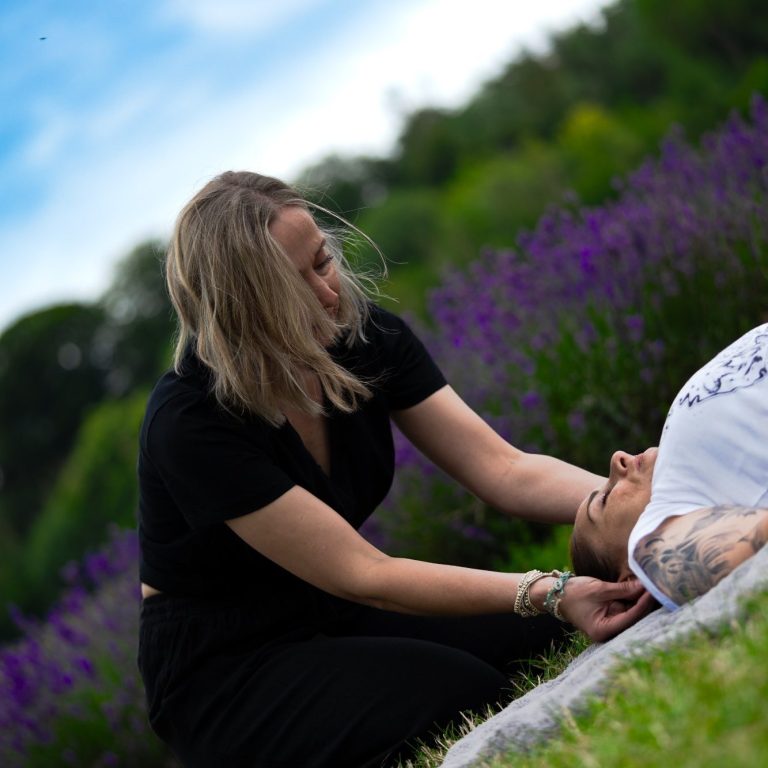
Breath is the key to accessing your body's story
“Trauma is not what happens to us, but what we hold inside in the absence of an empathetic witness.” — Peter A. Levine.
Trauma isn’t only about the events we lived through, it’s what stayed inside us because we had to face those moments alone.
When we didn’t have someone there to support us or help us understand what we were feeling, our body couldn’t fully process the experience. Instead, our nervous system and fascia held onto the stress, emotions, and overwhelm as a way of coping at the time. Creating armouring, coping mechanisms, beliefs about how we perceive the world and people around us, etc.
Many people come to breathwork not because they remember a single traumatic moment, but because they can feel the after-effects in their daily life, even if they can’t explain why:
- Feeling overwhelmed by small things
- Constant self-doubt or a sense of “not being enough”
- Struggling to relax or to feel present
- Repeating old patterns that no longer make sense
- Numbness, disconnection, or feeling “shut down”
- Carrying tension, tightness, or emotions you can’t quite name
- A sense that something inside you is asking to be released or understood
These responses aren’t personal failures, they’re signs that your body has been carrying experiences it never had the space, safety, or support to process.
A trauma-informed approach, including breathwork, embodiment, and therapeutic support, offers that “empathetic witness” you may not have had before. It gives your nervous system a safe place to unwind what’s been held inside for years, making room for relief, clarity, and emotional freedom.
You don’t need to relive the past to heal.
You simply need a safe space where your body finally feels supported enough to let go.